PHY2048C (Spring 2026)
Undergraduate course, Florida State University, 2026
Physics Studio A
- Instructor: Prof. Daniel D. Sega (email)
- Instructor’s Office: 2nd Floor, Faculty Wing
- Course Times: Spring 2025, Mon./Wed., 9:30 am-12:00 m. Mon. 1-3:30pm
- Location: 3rd Floor, Room 309
- Office Hours: 1st Floor, Faculty Wing or Room 309: M to F 12:15-12:45 pm
- Syllabus: See the most up-to-date version.
Summary
In this course, engineering and science majors will learn about the basic laws of motion in classical mechanics. They will learn how and why objects in our day-to-day move (or stay put) the way that they do, and will know how to predict projectile and rotational motion. They will also learn about the nature of scientific laws and the statistical nature of scientific measurements.
There’s a lot more information about this course – including details about the textbook, who should/shouldn’t take this class, and how your grade is calculated – in the syllabus.
Course Material
The primary “required readings” are in the OpenStax book University Physics 1 and the first section (thermodynamics) of University Physics 2. For some experiments in this class you will be using your phone, and the app phyphox, which you can download here. To set-uo the dit tutorial student must fill this Excell sheet
Here are some additional resources:
- An excellent, more abridged e-book for this course is available through the FSU Library Fundamental of Physics I. Give it a try if the OpenStax book treatment of a topic does not click with you. Ramamurti Shankar writes in a very particular voice that can help some students.
- This book is based on R. Shankar’s Open Course (Yale University), which is available online. These lectures were, and still are, a helpful resource for me.
- The phone app phyphox will be required in some of the labs, download here.
- Here is a worksheet to practice verbal algebra problems. Here is another one. Problems like this will be use to test your ability of translating English and concepts into equations, an essential skill in this class.
- Here are some examples of dit reading questions and mini-essay.
Schedule
Below is a detailed schedule that will list the material covered in each class session, links to electronic copies of any handouts and problem sets, and various course deadlines.
-
Wed., January 7: The Structure of Mechanics. Motion in 1D. (Chp. 1 & 3)
Handout: syllabus Homework 1 (Chp. 2 & 4) assigned, due Tue.,January 23. - Fri., January 9: No classes
- Mon., January 12: Vectors (Chp. 2) | Problem-Solving Session | Motion in 1D. Chp. 3
- Wed., January 14: Quiz Chp. 1 & 3 (Practice -> Solved) | Vectors, motion in higher dimensions. (Chp. 2 & 4)
- Fri., January 16: Vectors, motion in higher dimensions. (Chp. 2 & 4)
- Mon., January 19: Newton’s Laws I (Chp. 5)
- Wed., January 21: Newton’s Laws II (Chp. 6)
-
Fri., January 23: Newton’s Laws II (Chp. 6)
Lab 1: Measurements and dimesions Homework 1 due. Homework 2 (Chp. 5 & 6) assigned, due Tue., February 9. - Mon., January 26: Problem-Solving Session | Newton’s Laws I & II (Chp. 5 & Chp. 6)
- Wed., January 28: Quiz Chp. 5 & 6 (Practice -> Solved)
-
Fri., January 30: Work | Conservation of Energy in 1D (Chp. 7)
Extra credit reading: What is Space?, due Fri., February 6 -
Mon., February 2: Conservation of Energy in 2D (Chp. 8) (2.5-hour lecture)
Handout: Conservation of Energy in 2D and Problems -
Wed., February 4: Problem-Solving Session | Conservation of Energy in 1D & 2D (Chp. 7 & Chp. 8)
Handout: Extra Conservative Forces in 2D Problems - Fri., February 6: Gravitation (Chp. 13)
-
Mon., February 9: Quiz Chp. 7 & 8 (Practice -> Solved)
Homework 2 due. -
Wed., February 11: Gravitation (Chp. 13)
Lab 2: measuring g (Pendulum) Homework 3 (Ch 10, 11 & 13) assigned, due Fri., March 2. -
Fri., February 13: Multiparticle Dynamics (Chp. 9).
Handout: Center of Mass of a Triangle - Mon., February 16: No Classes
- Wed., February 18: No Classes
- Fri., February 20: No Classes
-
Mon., February 23: Multiparticle Dynamics (Chp. 9)
Lab 3: Collisions in 1D - Wed., February 25:Problem-Solving Session | Multiparticle Dynamics, Conservation of Energy, and Gravitation (Chp. 9, Chp. 13)
- Fri., February 27: Quiz Chp. 13 & 9 (Practice -> Solved)
-
Mon., March 2: Rotational Dynamics I (Chp. 10)
Homework 3 due Homework 4 (Math & Ch 12) assigned, due Wed., March 25. - Wed., March 4: Rotational Dynamics II (Chp. 11)
-
Fri., March 6: Rotational Dynamics III (Chp. 12)
Lab 4, day 1: Rotating Frames -
Mon., March 9: Rotational Dynamics III (Chp. 12)
Lab 4, day 2: Rotating Frames Wed., March 11: Rotational Dynamics III (Chp. 12)
- Fri., March 13: Quiz Chp. 12 (Practice)
- Mon., March 16: Problem Solving Session | Rotational Dynamics II (Chp. 11) and III (Chp. 12)
- Wed., March 18: No Classes
-
Fri., March 20: Quiz Chp. 11 & 12 (Practice -> Solved) | Simple Harmonic Motion (Ch. 15)
Handout: Complex numbers -
Mon., March 23: Mathematical Methods
Handout: Complex numbers -
Wed., March 25: Simple Harmonic Motion (Ch. 15) (2.5-hour lecture)
Handout: notes on damped harmonic motion Homework 4 due. Homework 5 (Chp. 12 & 14) assigned, due Wed., Abril 17. - Fri., March 27: Problem Solving Session | Simple Harmonic Motion (Ch. 15)
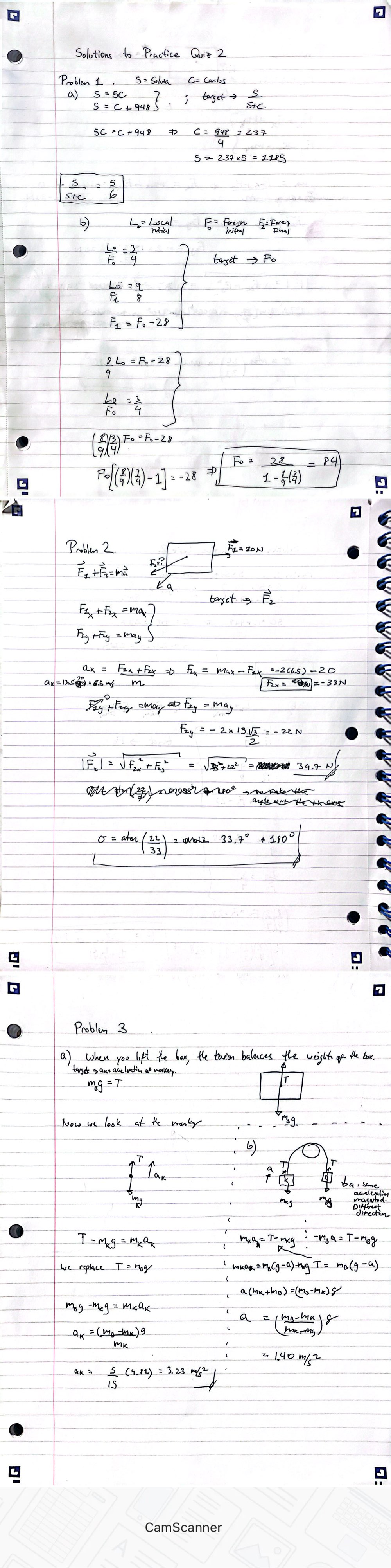

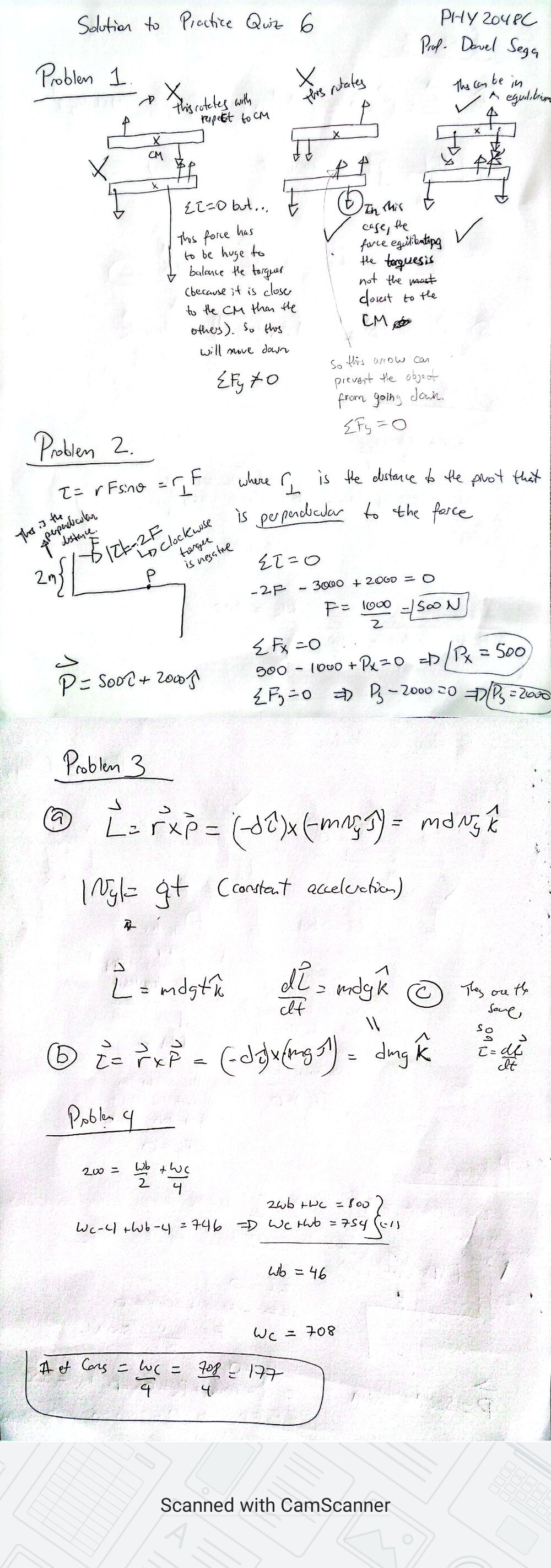
| Extra credit reading: What are waves?, due Fri. April 3
- Mon., March 30: Quiz Chp. 15 (Practice-> Solved) | Waves (Ch. 16)
- Wed., Abril 1: Fluid Statics (Ch. 14)
- Fri., Abril 3: No Classes
-
Mon., Abril 6: Fluid Statics (Ch. 14)
Lab 5: Archimides and Springs| Pre-lab: read Ch. 14.4 Wed., Abril 8: Waves (Ch. 16)
-
Fri., Abril 10: Fluid Dynamics and Sound Waves (Ch. 16 and Ch. 17)
Handout: notes on the Navier-Stokes equation and the wave equation - Mon., Abril 13: Fluid Dynamics and Sound Waves (Ch. 16 and Ch. 17)
Wed., Abril 15: Problem Solving Session | Waves and Sound Waves (Ch. 16 and Ch. 17)
-
Fri., Abril 17: Sound Waves (Ch. 17)
Lab 6: Speed of sound experiment | Pre-lab: re-read Ch 17.2 and watch this video Homework 5 due Mon., Abril 20: Problem Solving Session | Sound Waves, Waves, and Fluids (Ch. 14, Ch. 16, and Ch. 17)
Wed., Abril 22: Quiz Chp. 14, 16 & 17 (Practice) | Sound Waves, Waves, and Fluids (Ch. 14, Ch. 16, and Ch. 17
-
Fri., Abril 24: Heat and Thermodynamics I (Ch. 1b) and Ch. 2b)
Lab 7: Thermal Expansion Pre-lab: re-read Ch 1.4b
[Final Exam Mon., Abril 27. (Practice)]